

I was on a coaching call last month with a leader who was frazzled to the point of stuck. Overdrive and overwhelm. Too much on her plate, too many people looking to her for decisions. Decisions she had to make fast, and often without the knowledge she needed to make them.
We're in a hell of a time right now. Magnificent. Exciting. Also ambiguous, accelerating, demanding.
So how are you making these decisions? I asked.
She told me she'd started leaning on AI. Especially for the stuff she didn't understand well. Like AI itself.
Curious, I said. How's that going?
Sometimes amazing, she said. But I'm noticing a pattern. I need a lot of information and a lot of certainty before I'll commit to anything. So I keep pushing the AI for more. And it kept telling me "this is the answer" with total conviction. Then I'd question it, and it would praise me for questioning it, and serve up something completely different. By the end I had so many confident opinions pointing in so many directions that I froze. Stuck. No idea what the right move even was.
And there it is. The red flag.
When Information Makes Leadership Decision-Making Harder
We're living in an age where information is almost unlimited. That should make decision-making easier. Sometimes it does.
But more information doesn't necessarily create better decisions. Sometimes it creates more doubt, more second-guessing, and more opportunities to avoid making the decision altogether.
AI can make this even more complicated. It can give us an answer in seconds. It can offer different perspectives, challenge an idea, validate an assumption, and generate another five possibilities before we've even had time to think.
And that's useful.
But there's a catch.
AI can also reflect the assumptions we bring to it. If we're looking for certainty, validation, or permission not to decide, we can end up using the tool to reinforce the very pattern that's keeping us stuck.
That's not thinking. That's an echo chamber with better manners.
The Real Problem Isn't AI. It's Self-Awareness
Here's the part nobody wants to hear: the tool isn't necessarily the problem. Your blind spot might be.
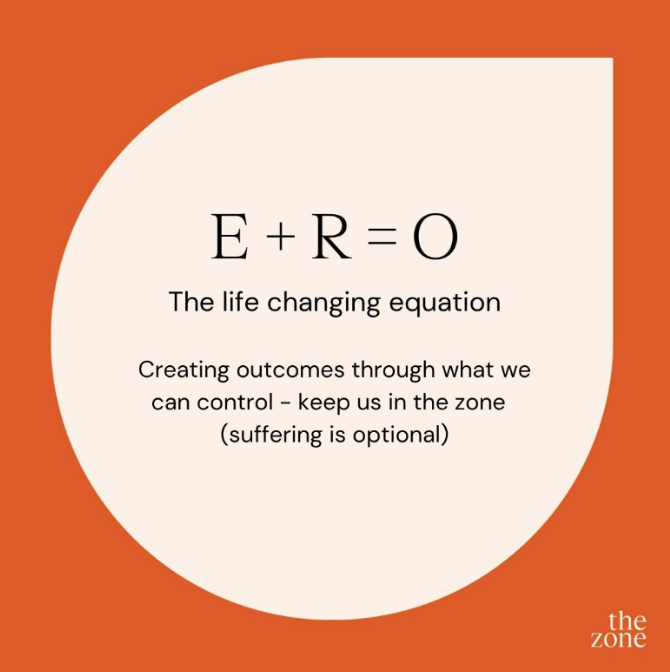
E + R = O.
Event + Response = Outcome.
The event was ambiguity, pressure, not enough information. Her response was to outsource the certainty she couldn't find in herself. That response is what built the stalemate, not the AI.
Which means the fix was never going to come from a better prompt.
It comes from knowing your own default.
What is Your Default Decision-Making Pattern?
Are you someone who needs certainty before you'll move, and will chase it in circles until someone hands it to you? Are you someone who trusts a first instinct and never questions it hard enough? Are you someone who reads a room brilliantly but folds the second there's real pushback?
Do you overanalyze? Do you seek consensus when what you actually need is courage? Do you make fast decisions because you're decisive, or because sitting with uncertainty makes you uncomfortable?
Whatever it is, that pattern was running you long before AI showed up. AI just found it, and started serving it back at scale, dressed as truth.
And this matters because leadership decision-making rarely happens in perfect conditions. Leaders make decisions with incomplete information. They make decisions under pressure. They make decisions when people disagree. They make decisions when the consequences aren't entirely clear. And sometimes, they have to decide before they feel ready.
Self-Awareness is a Leadership Capability
Self-awareness used to be a nice-to-have for leaders. A Sunday reflection. A values exercise. Something you got to eventually.
Not anymore.
In today's leadership environment, self-awareness is fundamental to good decision-making. Because before you can make a better decision, you need to understand how you make decisions.
What triggers you? Where do you seek certainty? What assumptions do you make under pressure? Whose approval are you looking for? What information do you ignore because it doesn't fit your existing view? And where might your own bias be influencing what you believe is an objective decision?
This is where leadership development becomes more than learning another framework or collecting another set of tools. It becomes about understanding yourself well enough to recognize what's happening in your thinking while it's happening.
Decision-Making Under Pressure Requires More Than Information
The leaders who navigate uncertainty well aren't necessarily the ones with all the answers. They're often the ones who can stay clear when there isn't an obvious answer.
They can distinguish between: "I need more information" and "I'm uncomfortable making the decision."
Those two things can feel remarkably similar. But they're not the same.
Sometimes more information genuinely improves a decision. Sometimes more information is simply another way of postponing one.
That's where leadership courage comes in. Not reckless certainty. Not pretending you know what you don't know. But being able to say: This is what I know. This is what I don't know. This is what I believe. And this is the decision I'm prepared to make.
That's decision confidence.
So, Decide Like You Mean It
The future of leadership isn't going to be about having access to more information. We're going to have more information than we know what to do with.
The differentiator will be knowing what to do with it.
Knowing when to listen. Knowing when to question. Knowing when you're being influenced by your own bias. Knowing when to ask for another perspective. And knowing when you've got enough information and it's simply time to decide.
AI can be an extraordinary leadership tool. But it shouldn't become your leadership brain.
Because the point of leadership isn't to eliminate uncertainty. It's to learn how to lead through it.
Know your bias before it gets fed back to you as gospel.
Know your patterns before they start making your decisions for you.
And know yourself well enough to decide when there isn't a perfect answer.
So. What's your default?
And who's actually making your decisions right now?
You, or the thing agreeing with you?
At The Zone Global, we believe exceptional leadership starts with the ability to lead yourself. Through executive coaching and leadership development, we help leaders build self-awareness, clarity, and the capability to navigate complexity, make better decisions, and lead with greater impact.
Next Post























.jpeg)


.png)


Let's work together
Our diverse global team can help you reimagine the future of your teams, leaders and organization. Get in touch.
Book your free 15-minute Clarity Call
Identify your key challenges
Explore tailored solution options
Show you how The Zone can accelerate your success
Take the first step toward real progress—schedule your call today.


