


It sounds provocative but it’s increasingly backed by data:
Your manager may have a greater impact on your day-to-day health than your doctor.
In modern workplaces, where people spend the majority of their waking hours, leadership isn’t just a performance lever. It’s a public health variable. The quality of management directly influences stress levels, psychological safety, burnout risk, and even physical wellbeing.
This isn’t opinion. It’s a pattern consistently reinforced by research from institutions like Harvard Business Review and Gallup.
The Hidden Health System: Your Workplace
Most organisations still treat wellbeing as a downstream initiative, something handled by HR programs, EAPs, or wellness perks. But the reality is simpler and more confronting: The single biggest driver of employee wellbeing is the person they report to.
Managers control:
- Workload and priorities
- Autonomy and trust
- Feedback and recognition
- Psychological safety
- Conflict dynamics
- Boundaries and expectations
In effect, they shape the daily emotional climate employees operate within. And that climate accumulates, positively or negatively, over time.
What the Research Says...
1. Managers Drive Engagement and Disengagement
Research from Gallup shows that:
- Managers account for at least 70% of the variance in employee engagement
- Poor management is a leading cause of employee turnover
- Disengaged employees report significantly higher levels of stress and burnout
When leadership is inconsistent, unclear, or reactive, it creates chronic cognitive load, a key contributor to fatigue, anxiety, and reduced performance.
2. Bad Leadership Is a Health Risk
Insights from Harvard Business Review highlight the physiological and psychological toll of toxic leadership:
- High-pressure, low-control environments elevate cortisol levels
- Lack of recognition is strongly linked to stress and disengagement
- Poor leadership behaviours can contribute to anxiety, depression, and burnout
In extreme cases, prolonged exposure to poor management creates stress responses comparable to major life stressors.
3. Loneliness at Work: A Silent Health Crisis
One of the most overlooked consequences of poor leadership is workplace loneliness. And the impact is not just emotional. It is biological. Research widely cited in leadership and organisational psychology, including work referenced in Harvard Business Review, shows that:
- Chronic loneliness can increase the risk of premature death by 26% or more
- Its health impact is often compared to smoking up to 15 cigarettes a day
- Social isolation is linked to higher rates of cardiovascular disease, anxiety, and depression
In workplaces, loneliness doesn’t always look like isolation. It shows up as:
- Feeling unseen or unheard
- Lack of meaningful connection with leaders or peers
- Transactional, task-only interactions
- Absence of psychological safety
And critically: Managers are the primary buffer or amplifier of workplace loneliness. A disconnected leader creates disconnected teams.
4. Psychological Safety Is a Health Lever
When employees don’t feel safe to:
- Speak up
- Ask questions
- Admit mistakes
They operate in a constant state of vigilance. This activates the body’s stress response system repeatedly.
Over time, that leads to:
- Emotional exhaustion
- Reduced cognitive performance
- Increased absenteeism
- Lower resilience
Great managers reduce this load. Poor managers amplify it.
The Cost of Getting It Wrong
Organisations often underestimate the downstream impact of ineffective leadership.
It shows up as:
- Increased sick leave
- Presenteeism, showing up but not functioning
- High turnover
- Low discretionary effort
- Cultural erosion
But beneath those metrics is something more fundamental:
People’s health is being shaped daily by how they are led and how connected they feel.
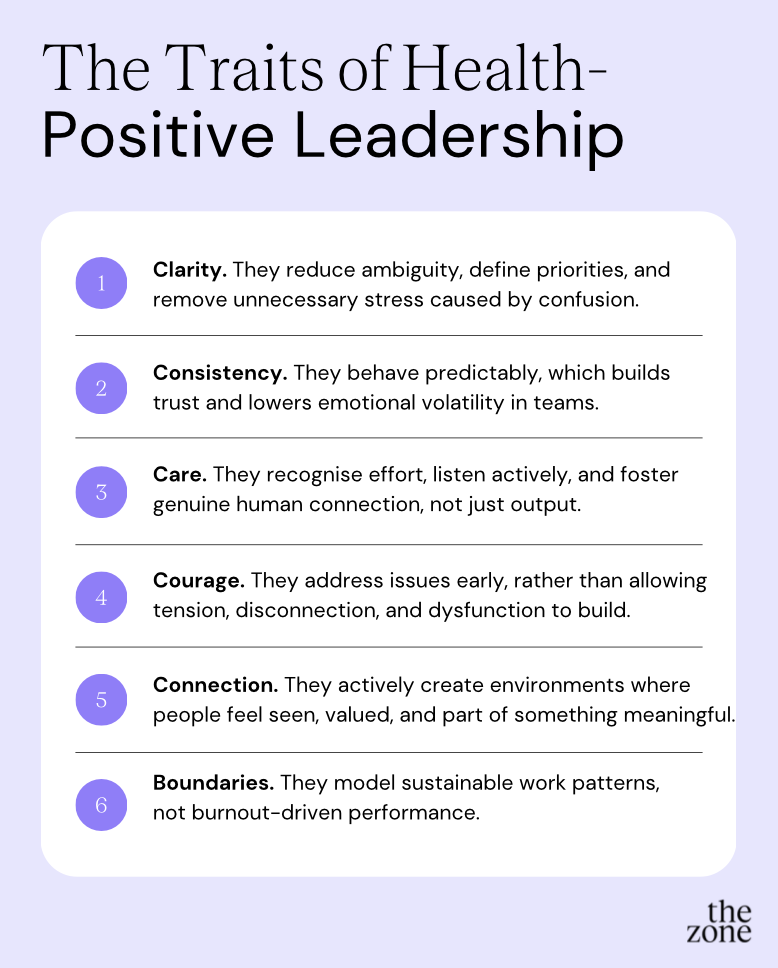
The Traits of Health-Positive Leadership
If managers are a health variable, then leadership capability becomes a preventative strategy. High-impact leaders consistently demonstrate:
1. Clarity
They reduce ambiguity, define priorities, and remove unnecessary stress caused by confusion.
2. Consistency
They behave predictably, which builds trust and lowers emotional volatility in teams.
3. Care
They recognise effort, listen actively, and foster genuine human connection, not just output.
4. Courage
They address issues early, rather than allowing tension, disconnection, and dysfunction to build.
5. Connection
They actively create environments where people feel seen, valued, and part of something meaningful.
6. Boundaries
They model sustainable work patterns, not burnout-driven performance.
Why This Matters More Now
Work has fundamentally changed:
- Hybrid environments reduce organic connection
- Always-on communication increases pressure
- Economic uncertainty heightens stress
- AI and transformation create constant disruption
In this environment, the risk of invisible burnout and silent loneliness is higher than ever. Which means leadership is no longer just about results. It is about regulating both performance and human experience.
A Leadership Reframe
Instead of asking: “How do we improve performance?”
Leaders should be asking: “What is the experience of being managed by me, and what is it doing to people over time?”
Because the answer determines:
- engagement
- retention
- culture
- wellbeing
- and ultimately, results
The Bottom Line
Doctors influence your health episodically. Managers influence it daily.And in a world where loneliness can be as harmful as smoking, and stress is a constant undercurrent of modern work, the role of leadership has fundamentally shifted. Leaders are not just performance drivers. They are health influencers.
A Challenge for Leaders
If you lead people, consider this:
- Do your behaviours reduce or increase stress?
- Do people leave conversations with you clearer or more anxious?
- Do people feel connected or invisible?
- Are you creating energy or draining it?
Because whether intentional or not, every leader is shaping health outcomes.
The question is:
Are you doing it by design or by default?
The Zone Global supports organisations in building positive leaders and high-trust teams through practical leadership development, coaching, and culture transformation. The focus is on strengthening how leaders show up every day, improving both performance and wellbeing so teams can thrive under pressure, not just perform within it.
Next Post
.png)
.png)



























.jpeg)


.png)


Let's work together
Our diverse global team can help you reimagine the future of your teams, leaders and organization. Get in touch.
Book your free 15-minute Clarity Call
Identify your key challenges
Explore tailored solution options
Show you how The Zone can accelerate your success
Take the first step toward real progress—schedule your call today.


