

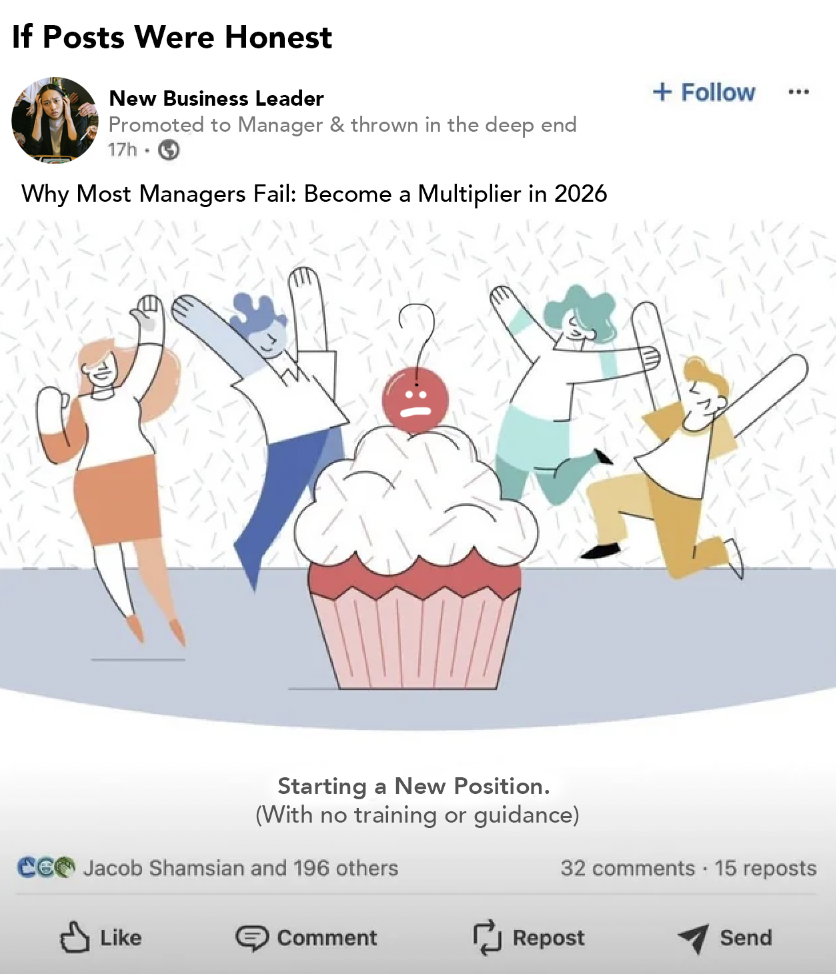
Why Most Managers Never Get Proper Training—and How They Can Become Multipliers in 2026
In today's fast-paced business world, effective leadership isn't just a nice-to-have—it's essential for driving team success and organizational growth. Yet, a staggering number of managers step into their roles without adequate preparation, leading to survival-mode leadership that stifles potential. Drawing from recent research, this post explores why so many managers lack proper training, the ripple effects on teams, and how embracing the "multipliers" mindset—versus being a "diminisher"—can transform outcomes. With leadership development trends evolving rapidly in 2026, now is the time for managers to shift from merely surviving to truly thriving.
The Alarming Reality: Most Managers Are Thrown into the Deep End Without Training
Imagine being promoted to a management position based on your stellar individual performance, only to find yourself navigating complex team dynamics, conflict resolution, and strategic decision-making with no roadmap. This scenario is all too common. Estimates show that 50-60% of first-time managers receive no formal training in their new roles. A 2016 survey revealed that 98% of managers believe their peers need more training to handle critical issues like professional development and employee turnover. Fast-forward to 2025 data, and only 44% of managers report receiving any job-specific training, leaving the majority feeling out of their depth.
Over the past five years, on-the-job training for managers has declined sharply, dropping by an average of 19 days compared to just four days for non-managers. Globally, 82% of bosses are classified as "accidental managers," promoted without formal leadership preparation, a figure that has risen since the pandemic. Even more concerning, 66% of managers in recent polls admit to no formal training, often leading to repeated requests for support that go unanswered. Without this foundation, managers learn through trial and error, mastering survival tactics but rarely excelling in ways that elevate their teams.
This lack of preparation isn't just a personal hurdle—it's a systemic issue. A whopping 60% of new managers fail within their first 24 months due to insufficient leadership skills training. In 2025, over 90% of managers cited time constraints as a barrier to participating in available programs, with 63% finding the role harder than anticipated. As organizations prioritize short-term results over long-term development, managers are left to "figure it out," perpetuating a cycle of mediocrity.
The Hidden Costs: How Inadequate Training Harms Teams and Organizations
When managers lack proper training, the fallout extends far beyond their own stress levels. Poorly equipped leaders create unnecessary work and tension, with 84% of U.S. workers blaming bad managers for increased stress and inefficiency. This often results in disengaged employees and diminished customer experiences, as untrained managers fail to coach effectively.
Productivity suffers directly: Untrained employees under such leadership produce lower-quality work and experience higher error rates, leading to decreased output and morale. Ineffective training programs exacerbate this, causing frustration and uncertainty that erode job satisfaction and loyalty. The ripple effect? High turnover—one in three workers quits due to poor management, costing organizations billions in recruitment and lost knowledge.
On a broader scale, inadequate management training fosters toxic environments, increasing burnout and disengagement while hindering innovation and well-being. Teams operate at reduced capacity, with Gallup noting that untrained managers double active disengagement rates. Ultimately, this leads to strained revenue, higher support demands, and a culture where potential goes untapped.
Surviving vs. Thriving: Understanding Multipliers vs. Diminishers
Many untrained managers default to "diminisher" behaviors—micromanaging, controlling decisions, and inadvertently draining team energy. In contrast, "multipliers" amplify intelligence around them, empowering others to contribute fully. This framework, popularized by leadership expert Liz Wiseman in her book Multipliers: How the Best Leaders Make Everyone Smarter, highlights how diminishers underutilize talent, often requiring twice the resources for the same output.
Diminishers create dependency through fear of irrelevance, leading teams to operate at just 20-50% capacity. Multipliers, however, challenge and unlock potential, fostering environments where teams deliver 70-100% of their capabilities. By trusting and supporting others, multipliers stretch limits without squandering resources. The good news? Multiplier leadership can be learned, even by reformed diminishers.
2026 Leadership Trends: Opportunities for Growth and Transformation
As we enter 2026, leadership development is shifting toward human-centered, agile, and AI-integrated approaches. Key trends include prioritizing well-being and empowerment in human-centered leadership, building purpose-driven cultures, and emphasizing continuous upskilling to combat shrinking skill lifespans. Organizations are moving away from generic programs to personalized, strategy-aligned training, with a focus on emotional intelligence, empathy, and psychological safety.
The rise of "bionic workers"—humans augmented by AI—demands leaders skilled in discernment and collaboration. Flatter structures and hybrid models require influence without authority, while lifelong learning becomes a retention strategy. These trends offer managers a chance to evolve into multipliers by integrating AI fluency, adaptive strategies, and skills intelligence into their development.
Becoming a Multiplier: Practical Steps for Managers
To move from diminisher to multiplier, start by self-assessing: Do you micromanage or empower? Wiseman's research shows multipliers extract twice the capability from teams by challenging without controlling. Here are actionable steps:
- Foster Autonomy: Let go of the "choke chain" and give teams space to innovate.
- Amplify Intelligence: Ask questions that stretch thinking rather than providing all answers.
- Build Psychological Safety: Encourage ideas without fear, unlocking 70-100% team potential.
- Seek Training Proactively: Leverage 2026 trends like personalized programs and AI tools for growth.
- Measure Impact: Track team engagement and output to refine your approach.
By investing in these habits, managers can not only survive but help their teams reach full potential.
Time to Multiply Your Leadership Impact
The gap in management training is a solvable crisis with profound implications. In 2026, as trends emphasize human potential and adaptive skills, managers have unprecedented opportunities to become multipliers. Don't wait for your organization—take the initiative to learn, empower, and thrive. Your teams, and your career, will thank you.
Get The Support To Succeed
The harsh reality is clear: most new managers are thrust into leadership without the tools or training needed to thrive, often defaulting to survival mode that limits both personal growth and team potential. But it doesn't have to be that way. At The Zone Global, with over 25 years of proven expertise, we specialize in transforming capable "doers" into exceptional, multiplier leaders through tailored executive coaching, our comprehensive five-stage leadership development program, and targeted support for building self-awareness, emotional intelligence, and effective team dynamics. We guide you through those critical first 90 days—and beyond—helping you establish credibility, foster psychological safety, empower your team, and set a foundation for long-term success and high performance. Don't navigate the leadership transition alone. Book your free 15-minute Clarity Call (or discovery call) today and discover how The Zone can provide the personalized guidance, practical tools, and ongoing support to help you win those first 90 days and unlock your full leadership potential.
Sources
- 82% of managers are "accidental managers" (promoted without formal leadership or management training) Chartered Management Institute (CMI) in partnership with YouGov. "Bad Managers and Toxic Work Culture Causing One in Three Staff to Walk" (2023 report, widely cited through 2025–2026).https://www.managers.org.uk/about-cmi/media-centre/press-releases/bad-managers-and-toxic-work-culture-causing-one-in-three-staff-to-walk/ Full report PDF: https://www.managers.org.uk/wp-content/uploads/2023/10/CMI_BMB_GoodManagment_Report.pdf
- Only 44% of managers globally have received formal management training Gallup. State of the Global Workplace: 2025 Report. https://www.gallup.com/workplace/349484/state-of-the-global-workplace.aspx
- On-the-job training decline and barriers like time constraints (e.g., time as top obstacle, with managers less likely to support development) Gallup. "Addressing the Barriers Blocking Employee Development" (2025).https://www.gallup.com/workplace/692642/addressing-barriers-blocking-employee-development.aspx
- 60% of new managers fail within their first 24 months (due to lack of leadership training) Gartner and Center for Creative Leadership (CCL) research, cited in Wharton Executive Education analysis (2024–2025).https://executiveeducation.wharton.upenn.edu/thought-leadership/wharton-at-work/2024/09/new-leaders-need-training
- Impacts of poor management (e.g., high turnover, disengagement, productivity loss; managers drive 70% of engagement variance) Gallup. State of the Global Workplace: 2025 Report and related analyses.https://www.gallup.com/workplace/349484/state-of-the-global-workplace.aspx
- Multipliers access nearly twice the capability (Diminishers ~48–66% of team potential; Multipliers 95%+; ~2x output difference) Liz Wiseman. Multipliers: How the Best Leaders Make Everyone Smarter (Revised and Updated Edition). Harper Business, 2017 (research findings consistent in summaries and applications through 2025–2026). Book on Amazon: https://www.amazon.com/Multipliers-Revised-Updated-Leaders-Everyone/dp/0062663070Wiseman Group: https://thewisemangroup.com/books/multipliers/
- 2026 leadership trends (human-centered leadership, continuous upskilling, AI integration, career development champions, leadership training as top initiative) LinkedIn. Workplace Learning Report 2025 (insights extending into 2026 priorities). https://learning.linkedin.com/resources/workplace-learning-report Full PDF: https://learning.linkedin.com/content/dam/me/learning/en-us/images/lls-workplace-learning-report/2025/full-page/pdfs/LinkedIn-Workplace-Learning-Report-2025.pdf
Next Post
.png)
.png)































.jpeg)


.png)


Let's work together
Our diverse global team can help you reimagine the future of your teams, leaders and organization. Get in touch.
Book your free 15-minute Clarity Call
Identify your key challenges
Explore tailored solution options
Show you how The Zone can accelerate your success
Take the first step toward real progress—schedule your call today.


